How it works
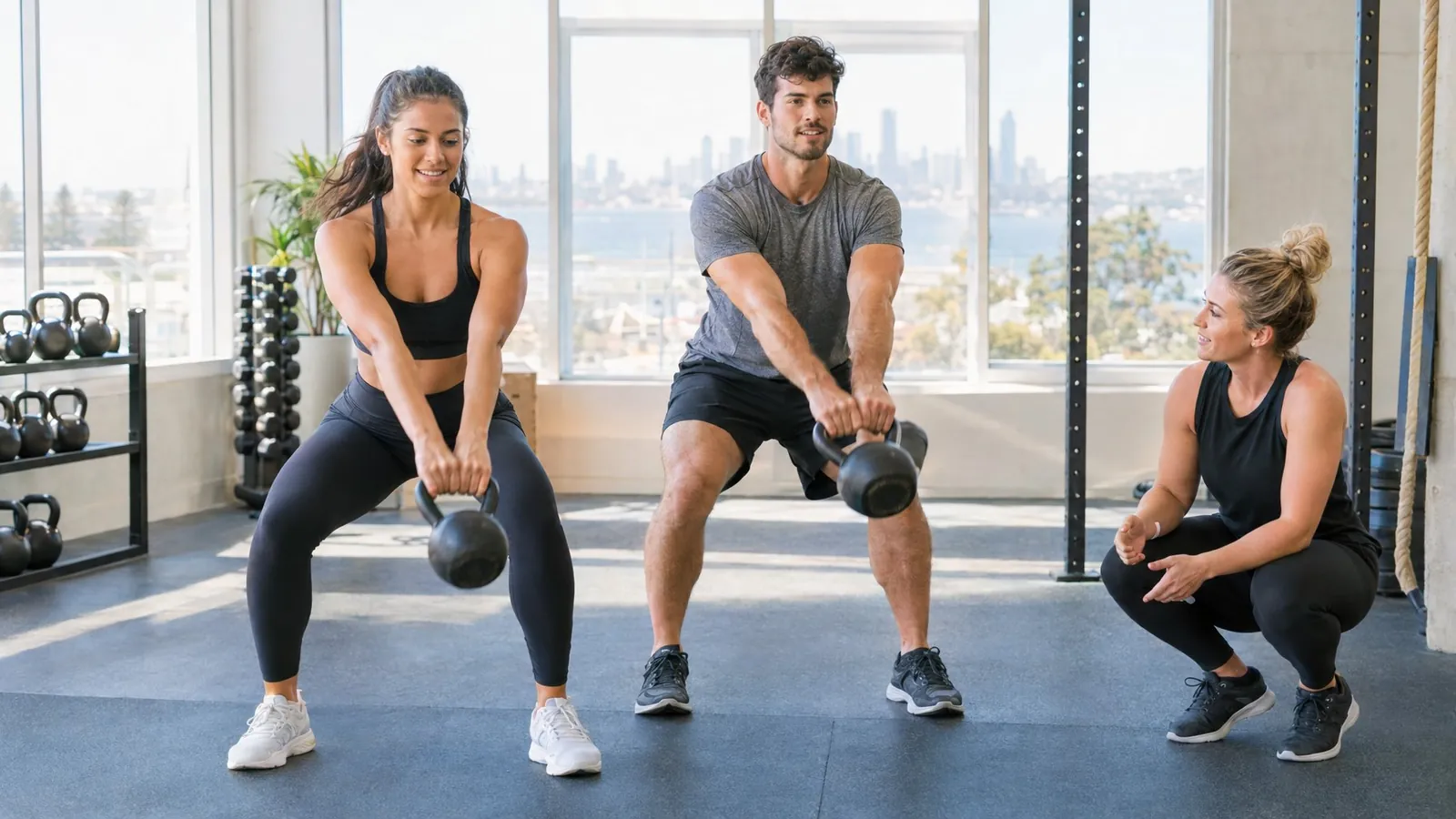
In partner training, two people share a trainer and a session. Small group training stretches that to a handful of people, often all following the same plan at their own level. The trainer still corrects technique and adjusts exercises, but their attention is shared, so you trade some individual focus for company and a shared commitment.
It suits friends who want to get fitter together, couples, workmates and anyone who finds it easier to turn up when someone is waiting for them. It can also be a gentler way in if one-on-one sounds a little intense.
How small is small?
There is no national definition, but councils set limits when groups train on public land, and those limits give a sense of scale:
- The City of Melbourne caps sessions under its park permit at 12 participants.
- The City of Sydney's voluntary outdoor fitness training code recommends groups of no more than 18 people.
- On the Gold Coast, boot camp, circuit, resistance or boxing style classes in parks are limited to 18 people including the trainer and support staff (City of Gold Coast).
- The City of Darwin's outdoor fitness permits allow a maximum of 20 participants at any one time (City of Darwin).
Those are ceilings for outdoor classes, not targets. Many trainers keep small group sessions well under them so everyone gets proper attention. Ask how many people will be in your group and whether that number is capped.
What a partner session looks like
Two people rarely want exactly the same thing. One might be chasing strength while the other wants to run further, or one has trained for years while the other is brand new. A trainer will often build the session around shared warm-ups and finishers, then split the middle so each of you works on your own focus, swapping stations as you go. Tell them up front what each of you wants so they can plan it that way.
Personal trainer or group instructor?
Australia's training system separates the two roles. The Certificate III in Fitness reflects the work of group and gym fitness instructors, where personalised instruction is limited (training.gov.au). The Certificate IV in Fitness reflects the personal trainer role, built around personalised programs. If you want a plan shaped to you inside a group, ask who will run the sessions and how they will tailor them.
Questions to settle before you start
- Is the group open to newcomers, or fixed for a set number of weeks?
- What happens if your training partner drops out or misses a week?
- Where does the group meet, and what is the plan when it rains?
- If the group trains outdoors, does the trainer hold the council permit for that spot?
Outdoor groups keep council hours as well. In Mackay, for example, permitted fitness sessions run in set morning and evening windows, and no loud music, loudspeakers or megaphones are allowed (Mackay Regional Council). On the Sunshine Coast, the council gives personal training on community land as an example of a low-use, low-impact business activity (Sunshine Coast Council).
Looking for a group, or a trainer for you and a friend? Send one enquiry and mention who will be training. We pass it to one local trainer.
Training with others
Can my partner and I be at different fitness levels?
Yes. A trainer can give you both the same session with different loads, speeds or versions of each exercise. Mention it in your enquiry so they can plan for it.
Do we both need to fill in the form?
No. One enquiry is enough. Say in the notes that you would like to train with a partner or a friend, and how many of you there are.
Is small group training the same as a fitness class?
Not quite. A class usually follows one routine for everyone in the room. Small group training keeps numbers low so the trainer can adjust the work for each person.